Description
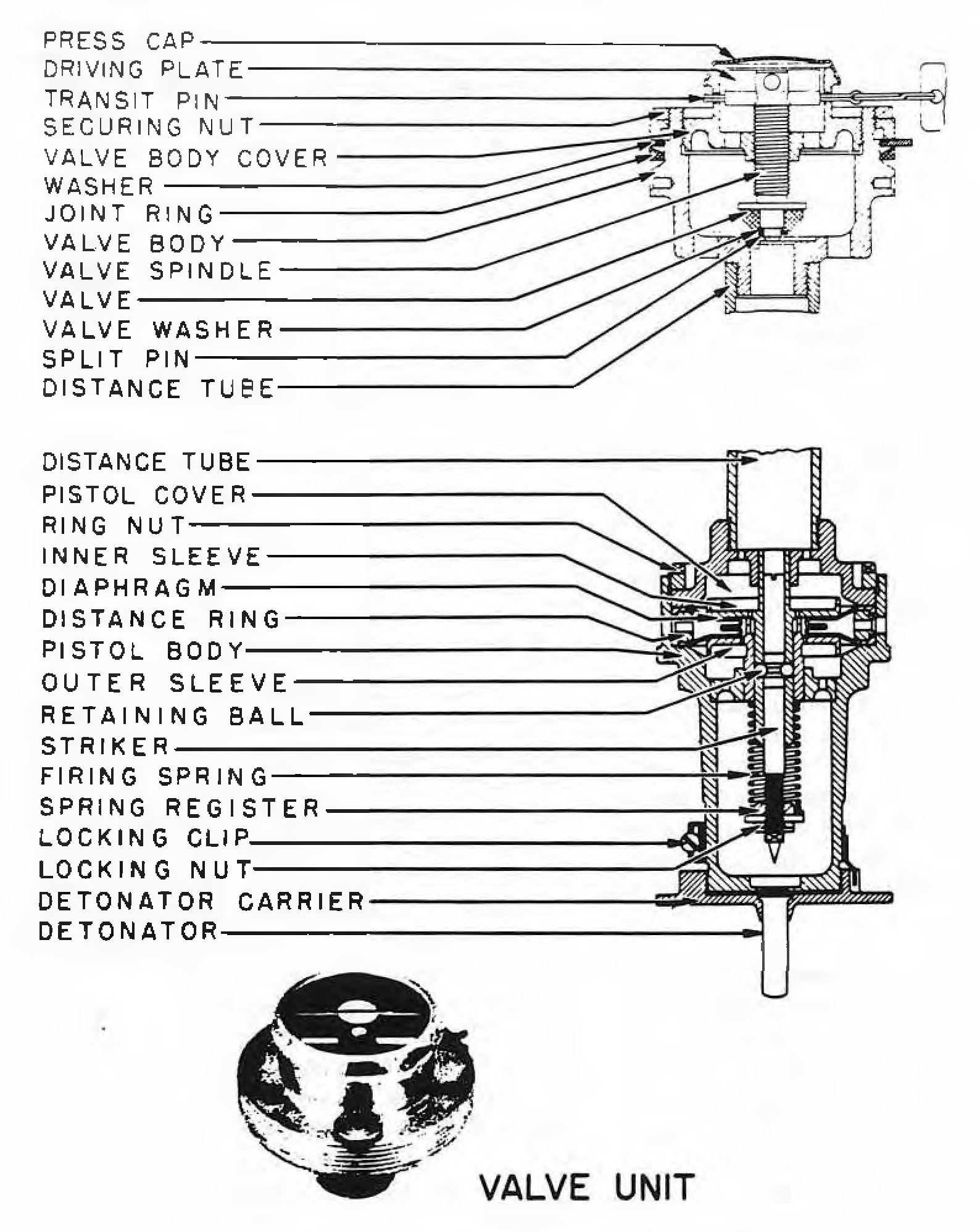
The pistol and valve units are separated by a distance tube. The valve body is internally threaded to receive the valve cover, which is drilled centrally and tapped to accommodate the valve spindle. To the top of the valve spindle is fixed an arming fork, which engages a similar fork on the end of the reach rod of a standard British tail unit. On the lower end of the valve spindle is a shoulder to which is fitted a beveled rubber washer, secured to the shoulder by a cotter pin and fitting into the lower valve body. The valve cover screws into the valve unit and is held in place by a set screw.
On the lower end of the distance tube is located the pistol assembly. The cover of the pistol body is threaded to the distance tube and is held into the pistol body by a locking ring. Around the sides of the pistol body are six water entry ports, extending through the distance piece, which fits into the rubber diaphragm. The diaphragm is located between an inner and an outer sleeve. In the inner sleeve are two holes containing retaining balls, which engage and retain the spring-loaded striker. The striker spring rests on a shoulder on the lower end of the striker, and on the outer sleeve, so that as the diaphragm expands and the sleeves move apart, the striker spring is compressed. The detonator carrier is threaded to the lower end of the pistol body.
Functioning
No information about functioning.
See Also
Nothing else to see.
Source(s)
OP 1665, British Explosive Ordnance (1946)
