Description
Used in early VT, PD, and MT nose fuzes to provide inbore safety.
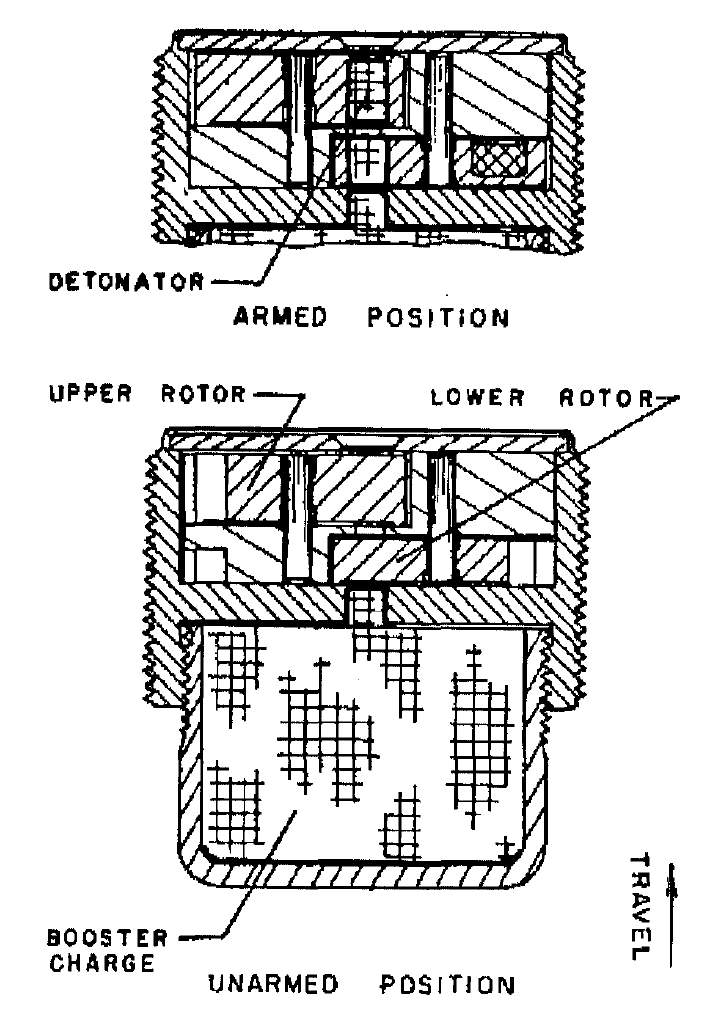
This fuze is constructed in two parts, a booster cup and a rotor housing into the base of which the booster cup is screwed. The rotor housing contains a double rotor assembly, one rotor located above the other. The upper rotor contains a primer detonator incorporating lead azide. The lower rotor contains a booster lead in of tetryl. In the assembled position, each rotor is locked by two centrifugal detents so that the components of the firing train are out of alignment.
The Auxiliary Detonating Fuze Mk 44 Mod 1 has a die cast motor housing; Mod 2 has a hole in the cover plate.
Functioning
The fuze is armed by centrifugal force, which causes the two sets of rotor detents to move outward against their springs, unlocking the rotors. The weighted rotors are then revolved by centrifugal force, until their motion is arrested by the stop pins. At this time the firing train is fully aligned, with the detonator immediately above the booster lead in, and the fuze is armed. When the nose fuze functions, the gas pressure thus generated forces through the weakened part of the closing disc and fires the detonator, which initiates the booster lead in and the booster.
Hazardous Components
No information about hazardous components.
See Also
Source(s)
MIL-HDBK-146, Fuze Catalog (1982)
OP 1664, Volume 1 - US Explosive Ordnance (1947)
