|
US Cartridge, 81mm Mortar Training Device, 81mm Sabot (Inert) M1 and 22mm Subcaliber Practice Cartridge M744, M745, M746, M747 |
Scroll Prev Top Next More |
Description
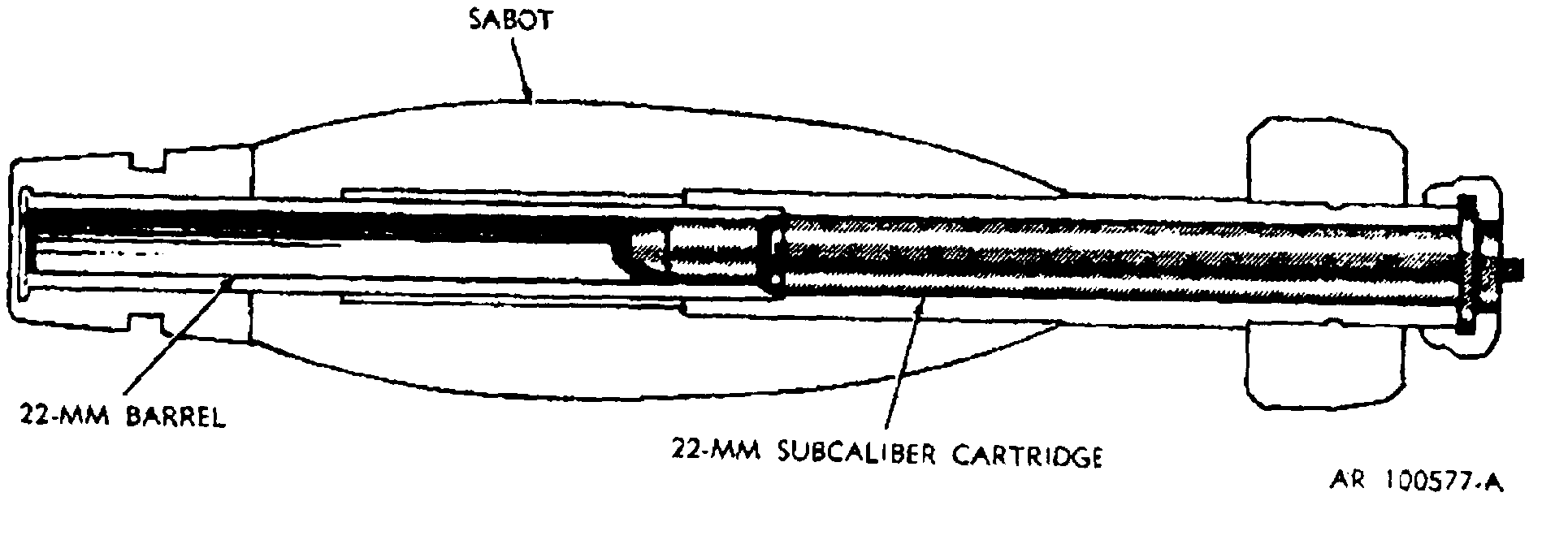
The sabot is designed to fire a 22mm subcaliber practice cartridge M744, M745, M746 or M747 (Charges 1, 2, 3, or 4 respectively) as a training device in all model 81mm mortars. The sabot with 22mm subcaliber practice cartridges provides realistic mortar firing training at distances which correspond to range firing distances in the ratio of 1 to 10. The subcaliber device can be fired using standard mortar and sighting and fire control equipment and special firing table in the same manner as standard service mortar ammunition.
The aluminum body sabot has the bore reading dimensions and configuration of an 81mm mortar cartridge. It contains an insert 22mm barrel (not rifled) placed longitudinally to receive the 22mm subcaliber cartridge which is loaded in the magazine just prior to firing. The shaft of the sabot has stabilizer wings and guide pads to guide the sabot as it travels up the mortar tube when fired. On firing, the loaded sabot is ejected from the mortar barrel and hits the ground within 1 to 5 yards (depending upon charge fired) in front of the mortar while the 22mm practice cartridge flies on to its target. The sabot may be used as a dummy round when not 1oaded with a 22mm practice cartridge. The sabot is rugged and can be reloaded and fired again up to 1000 times for training purposes. It is stored (INERT) in a packing box containing 3 rounds.
22mm Subcaliber Practice Cartridge - The cartridge consists of the projectile with stabilizer fins and cartridge case (divided chambers). The projectile has a steel body flattened at the tip. The wing-shaft assembly press-fit into the projectile body contains the stabilizer tins (spring steel wrapped around the shaft) to stabilize flight. The wing-shaft assembly also serves to seal the base of the projectile body. The projectile body contains the impact fuze and smoke signal charge. The propelling and ejection charges are contained in two separate chambers located in the jet-housing assembly, which is threaded into the base of the cartridge case. A flash tube hole between the chambers permits ignition of the propelling charge by the ejection charge. The cartridges are manufactured in a variety of four propellant charges. Each charge can be identified by notches on the jet screw assembly. One notch designates M744 (Charge 1), two notches designate M745 (Charge 2), etc.
Hazardous Components
No information about hazardous components.
See Also
Nothing else to see.
Source(s)
TM 43-0001-28, Artillery Ammunition (chg 11, 2003)
