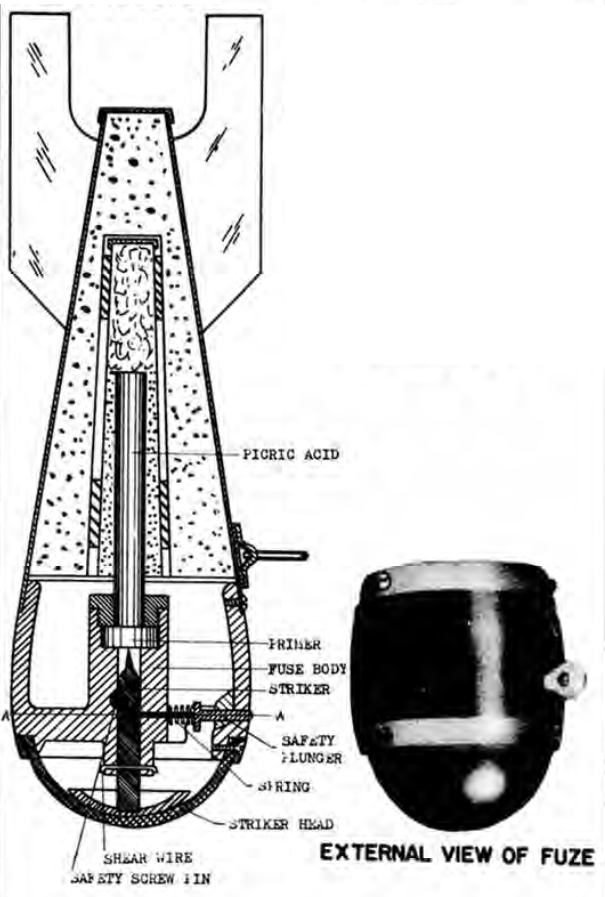
Description
The fuze body is inside the nose of the bomb and cannot be seen; it is part of the nose of the bomb. The striker head is attached to the spindle which has an integral firing pin. In the unarmed position the striker is held away from the detonator by a safety screw pin and a shear wire. When the bomb is attached to the bomb rack a small arm depresses a spring loaded safety plunger, the shaft of which fits into a hole in the striker spindle. The safety screw pin is then withdrawn.
Functioning
On release from the plane the spring loaded safety plunger is forced out of the striker spindle and the fuze is armed. On impact the striker assembly is driven inward shearing the shear wire and the firing pin pierces the primer.
This fuze has no creep spring. If the bomb has been dropped, the striker may be imbedded in the primer. Any slight movement may be sufficient to disturb the striker and to set off the bomb.
Hazardous Components
Primer and picric acid booster.
Physical Data
Length, overall (less booster) - 2.8 in (71.1 mm)
Width, overall (including fuze housing) - 3.0 in (76.2 mm)
See Also
Source(s)
OP 1667, Japanese Explosive Ordnance, Volume 1 (1946)
USNBD - Japanese Bombs & Fuzes (1944)
TM-E9-1984, Enemy Bombs and Fuzes, Section VII, Japanese Fuzes (1942)
