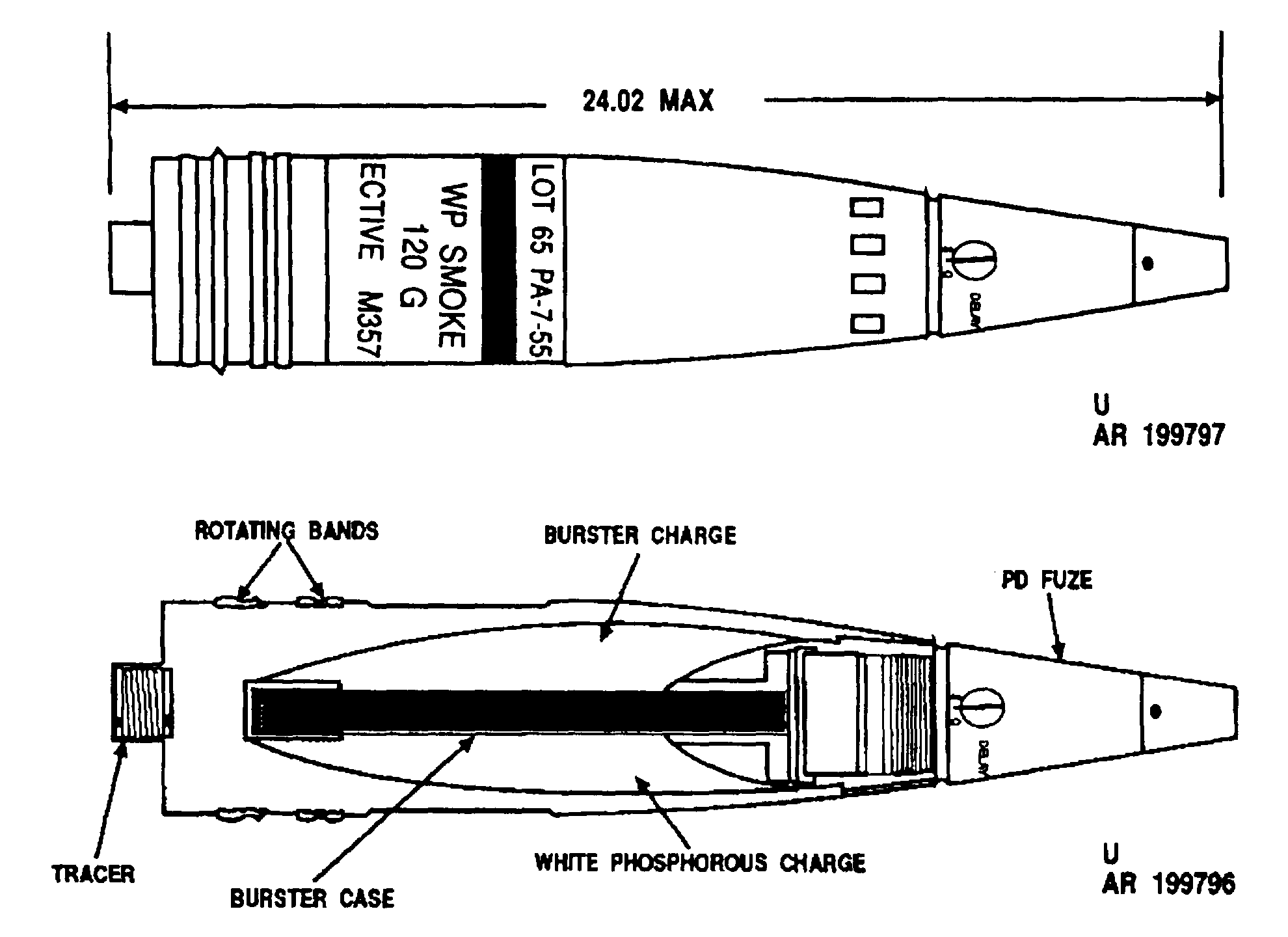
Description
This round is used in 120mm tank guns for target marking and smoke screening. It also has a limited incendiary action.
The complete round consists of projectile and propelling charge. The projectile is a forged steel body fuzed with a point-detonating (PD) fuze. Assembled to the projectile are two gilding metal rotating bands forward of the base. A boss containing a tracer is threaded into the base. A burster casing is press-fitted into the projectile nose with the other end seated in a well at the base of the projectile. A burster charge of tetrytol is contained in the burster casing. The propelling charge consists of a brass cartridge case containing the propelling charge in a silk bag. Distance wadding is used to hold the silk bag in place, and a plastic closing plug is used to close the mouth of the cartridge case. An electric percussion primer is installed in the base of the cartridge case.
The projectile is light green with a yellow band and light red markings.
Functioning
When the electric percussion primer is initiated in the breech of the weapon, the resulting flash ignites the propelling charge. The burning propelling charge generates gases that drive the projectile from the gun bore and ignite the tracer. The tracer provides a visible red trace during the first three seconds of projectile flight. The PD fuze functions on impact, detonating the burster charge. Explosion of the burster charge shatters the projectile body and disperses the White Phosphorus (WP, PWP). Upon contact with the air, white phosphorous spontaneously ignites and burns, producing a dense white smoke and flaming particles.
Hazardous Components
Filler - White phosphorous (WP) (7.5 lb, 3.4 kg)
Propelling charge assembly - M45 (T21E1)
Cartridge case - M109 (T25)
Propellant - M31
Primer - M67 (T85E3)
Tracer - M7
Burster casing - T20
Burster charge - M41 (T18) (1700 grains tetrytol)
Physical Data
Length, overall - 24.02 in, 610.1 mm
See Also
Source(s)
TM 9-1300-203, Artillery Ammunition (1967)
