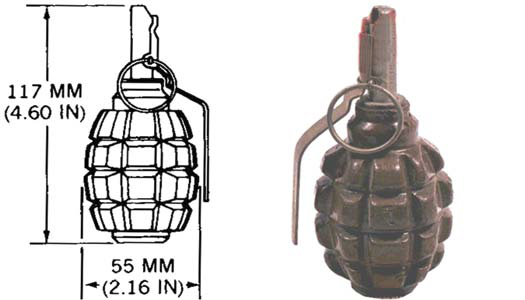
Description
These are hand thrown, defensive fragmentation grenades which may also be used as boobytraps. They use UZRG or UZRGM striker-release fuzing.
The F-1 Fragmentation Hand Grenade may be recognized by its outside resemblance to the US Fragmentation Grenade Mk II. The fuze assembly has a somewhat different appearance, but it has a safety lever and safety cotter pin very similar to the U. S. grenade mentioned above. The principle of arming, and the functioning of the fuze is, in general, similar to that of the fuze used in the US Fragmentation Grenade.
The F-1 may be gray, olive drab, or unpainted.
Functioning
The grenade is held tightly in the hand in such a manner that the safety lever is pressed firmly against the body and prevented from moving. The safety cotter pin is withdrawn by a pull on the ring, removing the obstruction against upward movement of the safety cap. When the grenade is thrown, release of pressure on the safety lever permits a ball release spring to raise the safety cap assembly, permitting the ball to fall out. This releases the striker, which is driven downward by the compressed striker spring to explode the primer. The safety cap and lever assembly are prevented from leaving the grenade by a locking pin. The primer, located in the delay body, initiates the delay train which, when it has burned through, explodes the detonator, thus causing detonation of the bursting charge of the grenade. The average delay is 4.4 seconds.
Hazardous Components
Filler - TNT 2.14 oz (60 g)
See Also
Fuze, UZRG
Fuze, UZRGM
Grenade, Hand, Defensive, Tip F-1
Grenade, Hand, Fragmentation, Delay, Mk 2
Source(s)
Basic Identification of Ammunition in Ukraine 5.0 (2023)
Explosive Ordnance Guide for Ukraine, First Edition (2022)
Explosive Ordnance Guide for Ukraine, Second Edition (2022)
Afghanistan Ordnance ID Guide, Volume 1 (2004)
Iraq Ordnance Identification Guide (2004)
DST-1160H-016-94, Hand and Rifle Grenades, Worldwide Identification Guide (1994)
Ordnance and Munitions, The XXI Century Encyclopedia
Intelligence Bulletin (June 1946)
